
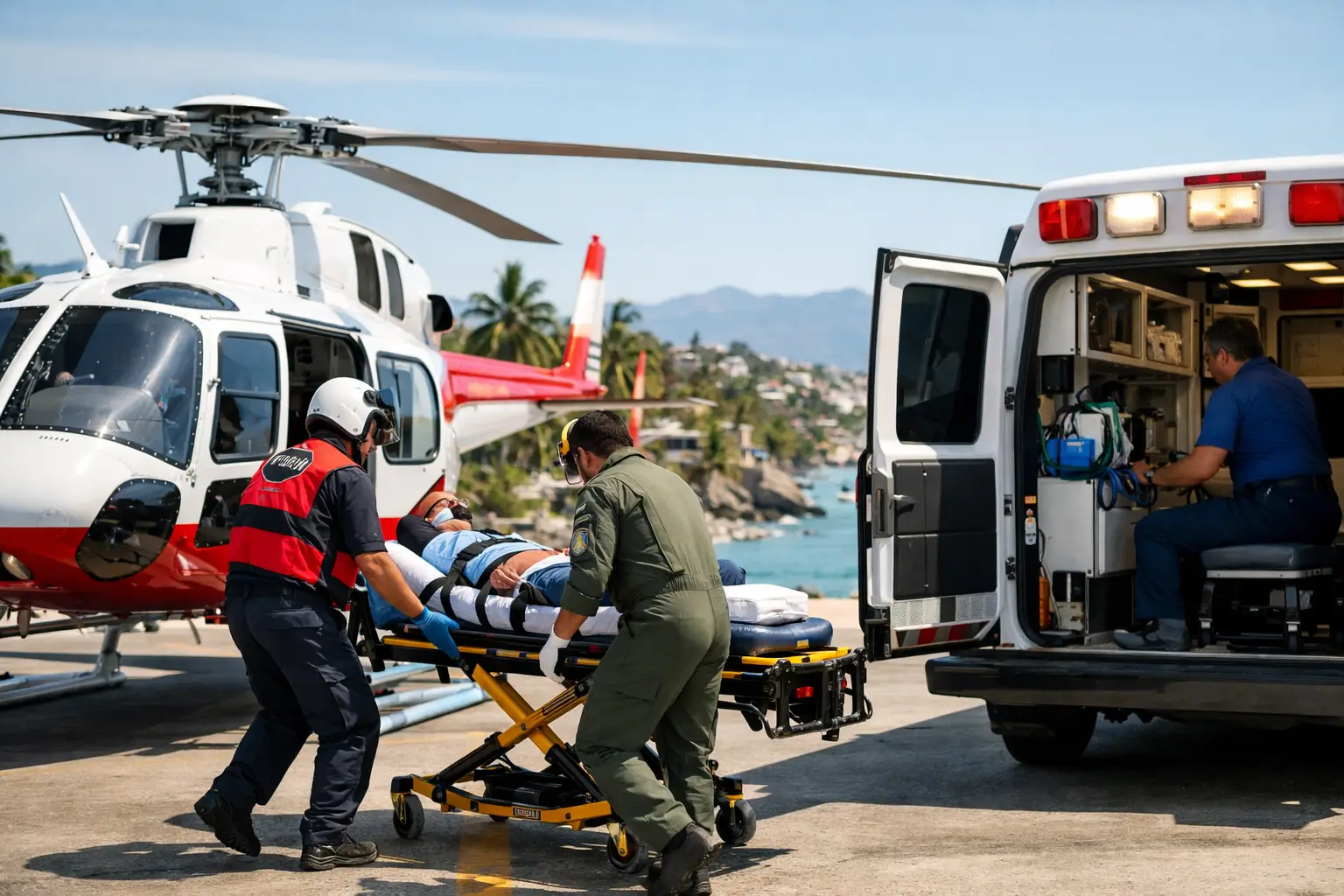
A serious medical emergency in Mexico is not always about whether a hospital can stabilize you. It may be about whether the right specialist, equipment, or follow-up care is available where you are. That is why people researching the best emergency evacuation memberships Mexico offers should look beyond the word “evacuation” and read exactly how a membership moves you, where it can move you, and who decides.
For expats, retirees, second-home owners, and long-stay visitors, an air medical transport membership can fill a gap that Mexican health insurance, U.S. Medicare, travel insurance, or a global health plan may not fully address. It is not a substitute for health insurance. It is a separate layer of protection for the logistical and financial challenge of getting home or reaching a higher level of care after a major medical event.
What an evacuation membership actually covers
Most air medical transport memberships are designed to arrange and pay for medically appropriate transportation after a covered illness or injury. Depending on the membership, this may involve an air ambulance, a medically staffed commercial flight, ground ambulance coordination, or bedside-to-bedside transport.
The critical distinction is whether the provider will transport you only when a local doctor says it is medically necessary, or whether it can transport you to a hospital near your home once you are stable enough to fly. Those are very different benefits.
A medically necessary evacuation benefit generally transfers a member to the nearest facility capable of providing appropriate care. If a qualified hospital is available in Cancun, Puerto Vallarta, Cabo San Lucas, Guadalajara, or Mexico City, the plan may not fly you to the United States or Canada simply because that is where you prefer to recover.
A hospital-to-home membership may offer more flexibility. With certain programs, a member hospitalized away from home can request transport to a home-area hospital after stabilization, even when local care is considered adequate. Eligibility, distance-from-home requirements, physician approval, and trip duration rules still apply, but this type of coverage is often the reason expats choose a dedicated membership.
The best emergency evacuation memberships in Mexico depend on your need
There is no single best option for every Mexico resident. The right membership depends on whether you want medical transport back to your home country, remote rescue capability, travel assistance, or a benefit that works alongside comprehensive health insurance.
Hospital-to-home medical transport memberships
These memberships are often the strongest fit for Americans and Canadians who maintain a home, family support, or preferred medical network north of the border. Programs in this category can arrange transport from a hospital in Mexico to a hospital near your home when you are hospitalized and medically stable for transfer.
The main advantage is choice. A major diagnosis can be emotionally and medically easier to manage near your regular physicians, adult children, or established support network. The trade-off is that these memberships commonly require you to be a defined distance from your home address, traveling for a limited number of consecutive days, and admitted as an inpatient. Routine outpatient care, planned procedures, and a desire to avoid a local hospital are not normally enough.
Ask whether the membership covers both air and ground transport, whether it includes a medical escort for a commercial flight when appropriate, and whether a companion can travel with you. Also confirm whether Mexico is included without geographic exclusions for your usual region.
Medical evacuation travel assistance plans
Travel medical plans and some international health plans may include emergency evacuation assistance. These benefits are useful, especially for short-term visitors and snowbirds, because they can coordinate a transfer when treatment is unavailable locally.
However, the insurer or assistance company usually controls the destination. The transfer is generally to the nearest suitable facility, not necessarily to your preferred hospital in Texas, Arizona, California, Ontario, or British Columbia. Coverage may also be subject to a policy maximum, preauthorization, and a medical-necessity determination.
This can be an excellent solution when paired with strong travel medical coverage, but it should not be mistaken for a membership that promises transport home after hospitalization. Compare the wording carefully before relying on it as your only evacuation protection.
Remote rescue and expedition memberships
Remote rescue-oriented memberships can make sense for people who spend time boating, hiking, diving, driving remote highways, or visiting areas far from a major hospital. Some programs can coordinate extraction from difficult locations and provide broader travel, security, or crisis-response services.
These plans are valuable for an active traveler, but they are not automatically the best fit for a full-time retiree in a well-served expat community. Their higher cost and specialized benefits may not be necessary if your primary concern is medical transport from a hospital in Mexico to your home area. On the other hand, someone living part-time in Baja, traveling by RV through rural Mexico, or making frequent adventure trips may find the added scope worthwhile.
Questions to ask before you buy
Marketing language can make several memberships sound identical. The policy terms tell the real story. Before you enroll, get clear answers to these questions:
- Does the membership provide transport only when medically necessary, or can it return me to a hospital near home once I am stable?
- Is Mexico included for all regions I visit or live in, including remote areas and islands?
- What counts as my home, and how far away must I be for coverage to apply?
- Is there a maximum trip length outside my home area?
- Does coverage apply to pre-existing conditions, and are there waiting periods for new members?
- Are ground ambulances, a travel companion, mortal remains transport, and return transportation for a vehicle or family member included?
Also ask what happens when you are unable to communicate. A good program has a 24-hour assistance center that coordinates directly with treating physicians, receiving facilities, and transport teams. You or a family member should not be trying to arrange an international air ambulance while dealing with a stroke, heart attack, serious infection, or trauma.
Memberships and health insurance work together
Mexican private health insurance and international health insurance are built to pay for medical treatment. An evacuation membership is built to arrange transportation. You may have excellent inpatient coverage at a private hospital in Mexico and still prefer the option to transfer closer to home after the immediate emergency has passed.
Conversely, an evacuation membership will not pay for your hospitalization, specialists, surgery, medications, or rehabilitation unless those benefits are specifically included elsewhere. This is why a coordinated review matters. Your health plan may already include evacuation benefits, but the destination rules and dollar limits may be narrower than you expect.
For example, a global medical plan may cover emergency evacuation to the nearest appropriate center. A separate hospital-to-home transport membership may add the ability to relocate after stabilization. The two can complement each other rather than duplicate each other.
Cost is not the only comparison point
Annual membership pricing is usually modest compared with the cost of a private air ambulance, which can reach tens of thousands of dollars or substantially more depending on the aircraft, medical crew, route, and urgency. That does not mean the least expensive membership is automatically the best value.
Look at the household structure. Some programs cover an individual, while others offer family memberships. Check age limits, renewal rules, and whether adult children or a spouse must be enrolled separately. If you divide your time between Mexico and the United States or Canada, confirm that your travel pattern fits the plan’s residency and trip-duration requirements.
Your medical history matters, too. A membership may accept pre-existing conditions, but that does not necessarily mean every transport request will qualify. The member still must meet the program’s medical and administrative requirements at the time of the event.
Choose based on where you want to recover
For many Mexico-based expats, the deciding question is simple: if I am hospitalized after a serious event, do I want to remain in the local medical system or recover near my established doctors and family? If returning home is the priority, focus on hospital-to-home transport language rather than a generic emergency evacuation limit.
If you are primarily concerned about being moved from a remote location to the nearest capable hospital, a rescue or travel-assistance option may be more appropriate. If you want both, it may make sense to combine a comprehensive health plan with a transport membership designed for your lifestyle.
Launa Brockman Expat Insurance can help review how an air medical transport membership fits alongside your Mexican or international health coverage. Before your next long stay, ask for the actual eligibility rules and transport destination language. Those details matter far more than a broad promise of “emergency evacuation.”